2025 Neurotrauma Reports

When the Brain Borrows

Coupling of Event-Related Potential and Pupil Dilation as a Compensatory Marker of Executive Attention in Traumatic Brain Injury

After a traumatic brain injury (TBI), the accuracy in an attention task can still remain high, but the time it takes to respond is longer. Both pupil and brain responses are found to be reduced compared to healthy individuals, yet in TBI they become more tightly linked. This may reflect a compensatory coupling between cortical attention and autonomic arousal systems

Explore the research work and its finding by scrolling through the page or read the article

Stylized eye with EEG and pupil signal overlays

The clinical problem

Attention deficits can hide behind preserved accuracy

Traumatic brain injury (TBI) often disrupts attention and executive functions such as decision-making, so how does an injured brain adapt to process a stimulus, resolve conflict, prepare a response, and regulate effort?

Physiology reveals hidden load Participants with TBI maintained accuracy but had slower reaction times, suggesting they needed more effort to perform the task. The study links that effort to measurable brain-body signals
Compensatory mechanism In TBI, reduced pupil dilation and reduced P3 brain responses were still positively coupled, unlike in controls. This suggests the injured brain may rely more on coordination between cortical and autonomic systems to stay focused
Multimodal biomarkers Combining EEG and pupillometry could help track recovery, stratify injury severity, and guide individualized rehabilitation strategies better than behavior alone
01

The Measurement

Multimodal recording of a complex system can provide more insightful information on how the system works

Simultaneous eye-tracking and EEG data were recorded at 500 and 1000 Hz, respectively using a high-density 128-channels EEG headset

Visual P300 ERP Cue Target 300-700 ms Amplitude and latency are interpreted as electrophysiological markers related to attentional resource allocation and stimulus processing (measured at Pz in the 300-700 ms post-target window)
Pupil dilation Marker or cognitive effort and locus coeruleus-norepinephrine engagement. Larger or more sustained dilation generally reflects greater task-evoked arousal or mental effort
02

The task

The Attention Network Test separates alerting, orienting, and executive control

Each trial starts from fixation, to cue, to target, to response
Incongruent flankers add conflict, making executive control more demanding
Reaction time is processed to determine performance

+Fixation
No Cue - (Lack of warning) Center Cue - (Temporal) Spatial Cue - (Temporal + Spatial)
→ → → → →
← ← ← ← ←
Congruent target ← ← → ← ←
→ → ← → →
Incongruent target
Response time (RT) is monitored
Alerting Benefit of temporal warning cue
RT(no-cue) - RT(center-cue)
Orienting Benefit of spatial warning cue
RT(center-cue) - RT(spatial-cue)
Executive control Cost of conflict resolution
RT(incongruent) - RT(congruent)
03

The cohorts

TBI patients and controls participated in the study

Participants were drawn from a larger longitudinal study
Severity of injury was assessed with intracranial neuroimaging
and Glasgow Coma Scale (GCS)
All had normal or corrected-to-normal vision

0Control subjects
0Subjects with TBI
7 ± 3Months post-injury in the TBI group
Distribution of Glasgow Coma Scale severity categories
04

Behavioral result

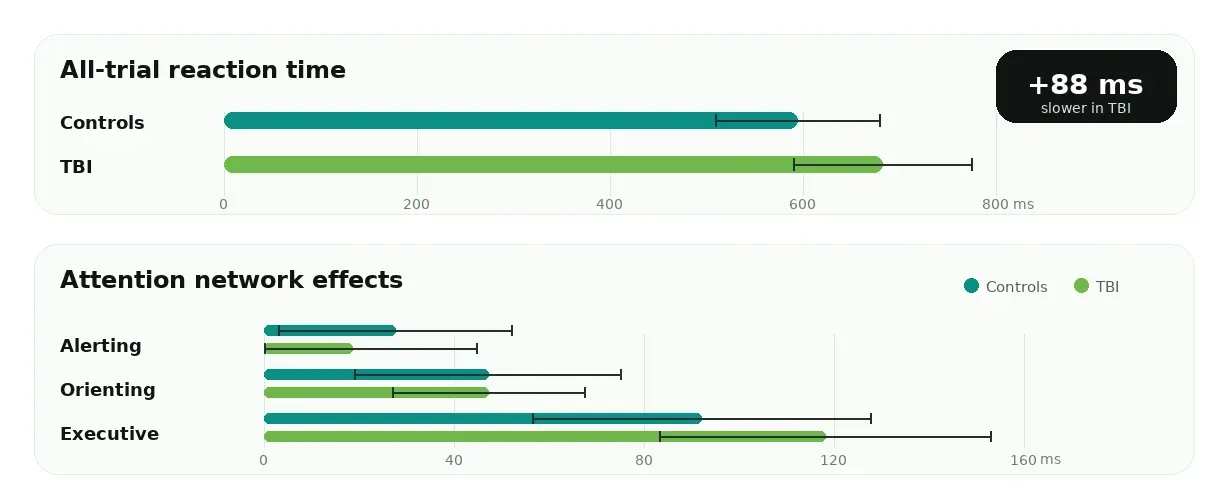
TBI participants stayed accurate, but responded more slowly

While accuracy was comparable between the cohorts (97.4% vs 97.3%), controls were clearly faster in providing the correct answers (p < 0.001) and in resolving conflicts (p < 0.005) compared to TBI

Horizontal bar charts showing behavioral
05

Data processing

Evolution of data from raw signals to analysis

Raster plots showing cue-aligned congruent trials with center-cue for one participant included in the pupil analysis
Pupil dilation is expressed by color with 0 representing missing data
(A) original, (B) cleaned, (C) interpolated, and (D) baselined
Grey dotted lines at time 0 ms mark the cue onset,
Black dotted lines mark target onset,
Red dotted lines response timing

Data preprocessing
06

Key discovery

Reduced P3 amplitude and reduced pupil dilation appear together in TBI

Grand-averaged cue-aligned pupil dilation and P3 event-related potentials at Pz for control and TBI cohorts, shown separately for each cue and target type

Across task conditions, the TBI group shows reduced P3 responses and reduced pupil dilation relative to controls
Despite this reduction, the two measures become positively linked in TBI,
consistent with compensatory coupling between cortical attention and autonomic arousal systems

P3 and pupil dilation

Proposed interpretation

Why might the eye and cortex become linked?

Reduced frontal monitoring may weaken top-down regulation of arousal, making stimulus-driven and autonomic responses more tightly coupled to cortical activity

TBI may involve impaired LC-NE signaling as the blunted pupil response may reflect reduced ability to adjust arousal during demanding tasks

TBI may limit flexible allocation of neural and autonomic resources, increasing reliance on arousal-driven compensatory mechanisms to maintain task performance

The study supports these as working hypotheses, not as proven causal mechanisms

Conceptual mechanism

Significance

Multimodal results matter beyond this study

This work suggests that EEG and pupil signals combined could provide a better marker of TBI-related cognitive dysfunction than any single measure or behavioral data alone

Hidden dysfunction

EEG and pupillometry can reveal altered processing even when behavioral preformance remains high, making them more sensitive for subtle deficits

Recovery tracking

EEG-pupil coupling could become a useful marker for longitudinal monitoring of cognitive recovery

Severity stratification

Multimodal pattern may help distinguish patients who behave similarly but differ in physiological burden, compensation, or injury severity

Mechanistic rehab

Interventions that target arousal regulation, executive control, or both may be evaluated against these coupled physiological measures rather than behavior alone

Personalized medicine

Because TBI is heterogeneous, joint cortical-autonomic metrics may help identify subgroups and tailor follow-up and rehabilitation strategies.

Translational value

The scenario of preserved behavior with altered internal physiology may apply broadly to other neurological conditions where compensation masks dysfunction

Back to top